
 English
  русский
  Español

Home / News / Industry News / Near Field Communication Stickers: Materials, Design and Application Guide
News

Near Field Communication Stickers: Materials, Design and Application Guide
2026-09-30
Near field communication stickers look like ordinary labels, and that is precisely their strength. Beneath a printed surface sits a small chip and a coiled antenna, ready to hand a phone a piece of digital information the moment someone holds it close. There is no battery to replace, no pairing screen and, in most cases, no app to install. For brands and packaging teams, a label that once carried only a barcode can now open a verification page, deliver usage instructions or launch a loyalty offer in a single tap.
What Is Inside a Near Field Communication Sticker?
NFC stickers operate at 13.56 MHz, in the same high-frequency family as contactless bank cards and transit tickets. Most commercial products follow ISO/IEC 14443 or ISO/IEC 15693, and are usually described by NFC Forum type: Type 2 for the familiar NTAG-style chips, Type 5 for ISO 15693 silicon. Memory ranges from a few dozen bytes to a few kilobytes, and the data is stored in NDEF records, the format that lets a smartphone understand a web address, a text note or a contact card without any custom software.
The tag is passive. It harvests its operating power from the field generated by the phone's reader, which means there is nothing to charge and nothing to switch on. Read range is short by design, typically only a few centimetres, and that short range is a feature rather than a limitation. A sticker can only be read by someone who deliberately brings a device within touching distance, so the interaction is intentional, private and easy to explain to a consumer.
NFC Stickers and UHF RFID Labels Are Not the Same Thing
The two terms are often used interchangeably in packaging conversations, and that leads to mismatched expectations. They share an ancestry in radio frequency identification, but they are built for different jobs. NFC stickers are designed for a deliberate tap by a person holding a phone. UHF RFID labels are designed for automated reading at a distance, where hundreds of items pass a fixed reader in a second.
| Characteristic | NFC stickers (HF) | UHF RFID labels |
|---|---|---|
| Frequency | 13.56 MHz | 860 to 960 MHz |
| Power | Passive, powered by reader field | Passive, powered by reader field |
| Typical read range | 1 to 10 cm with a smartphone | 1 to 10 m with fixed readers |
| Usual reader | Phone or tablet | Portal, handheld or tunnel reader |
| Data model | NDEF records, URLs, text | EPC number plus user memory |
| Typical purpose | Consumer tap, authentication, marketing | Inventory, logistics, asset tracking |
Choosing between them is rarely a question of one being better. When the goal is a consumer touchpoint, a warranty registration or an authenticity check, an NFC sticker is the natural answer. When the goal is a warehouse count, a shipping manifest or an asset register, a UHF label will do the work far faster.
How an NFC Sticker Is Built, Layer by Layer
An NFC sticker is a small laminate, and every layer has a job to do. A typical construction includes the following:
- Face material — coated paper, PET, PVC or a synthetic stock that carries the printed artwork and protects the chip.
- Antenna — aluminium etched or silver conductive ink printed, precisely tuned to 13.56 MHz.
- Chip and bonding — a small silicon die flip-chip bonded to the antenna pads, then encapsulated.
- Adhesive — permanent, removable, freezer grade or high tack, selected for the surface it must grip.
- Liner — silicone-coated paper or film that releases cleanly during application.
On metal surfaces, an extra ferrite layer or a thicker foam spacer is normally required. Without it, the metal detunes the antenna and the sticker can become effectively unreadable, which is one of the most common reasons a field trial disappoints.
Applications Where NFC Stickers Earn Their Keep
Because the interaction is instant and needs no app, NFC stickers fit wherever a brand wants to remove friction between a physical product and a digital service. Common programmes include:
- Brand authentication — a tap opens a verification page tied to a unique chip ID that is difficult to clone.
- Product information — ingredients, origin, usage instructions and care guidance served in the consumer's own language.
- Loyalty and coupons — points credited or a discount redeemed without scanning a code or typing a serial number.
- Retail engagement — shelf talkers, gift sets and limited editions that react to a tap with a campaign landing page.
- Premium drinks — bottle neck and back labels that confirm provenance and tell the story behind a vintage.
- Events and media — wristbands, posters and packaging that unlock tickets, playlists or downloadable content.
Beverage brands are a useful case in point, because glass, condensation and cold chain conditions all influence how a tag performs. Material selection on these curved, chilled surfaces deserves careful attention, and the same reasoning applies to any premium bottle programme.
Custom NFC tag labels for wine and spirits is a good illustration of how substrate, antenna size and adhesive choice are balanced against packaging aesthetics.
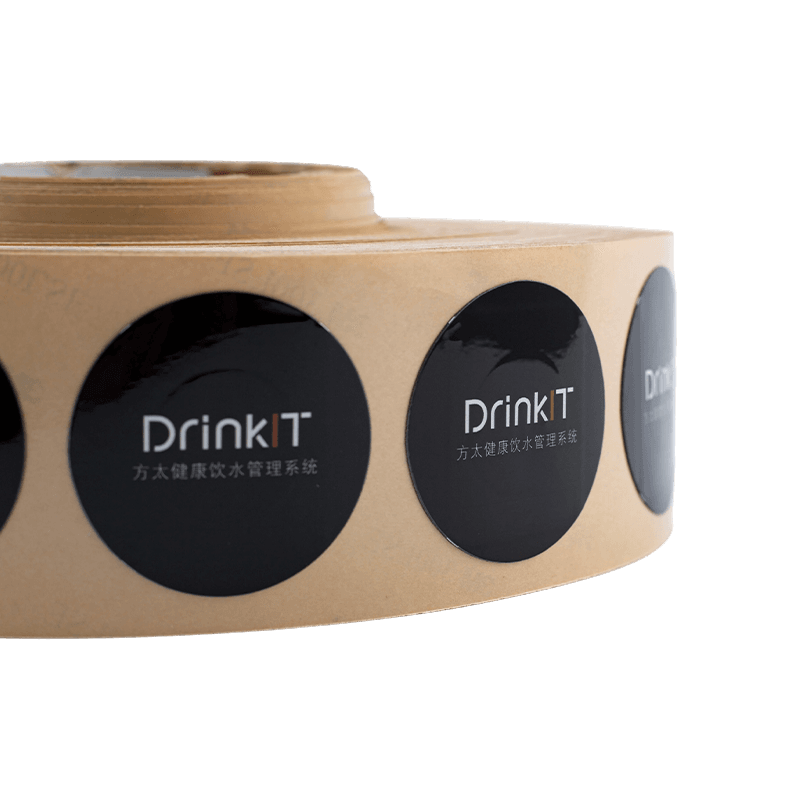 NFC brand anti-counterfeiting and interactive labelsAdvantages and Details: Built-in high-frequency (HF) NFC chip stores encrypted anti-counterfeiting information and digital content. Consumers can use an NFC-enabled ph...View Product →
Design Considerations That Decide Whether It Works
Metal, curves and liquids
Three environmental factors cause most NFC failures in the field. Metal reflects and detunes the field, so a ferrite isolation layer or a spacer is essential on cans, tins and foil pouches. Tightly curved surfaces such as small-diameter bottles and tubes can crack a rigid chip, so a flexible substrate and a smaller die are preferable. Liquids absorb high-frequency energy, which shortens the read range on filled containers and may require a repositioned antenna or a larger tag footprint.
Print, finish and placement
NFC stickers accept the same decorative treatments as conventional pressure-sensitive labels: metallic effects, matte varnish, transparent frosted film and special inks. What matters is that the finishing process does not sit on top of the antenna in a way that interferes with the field, and that the final placement instruction is clear. Telling a consumer to tap the middle of a bottle when the chip sits near the base is a reliable way to generate poor engagement data. Prototype early, test with several phone models, and document where the tap should land.
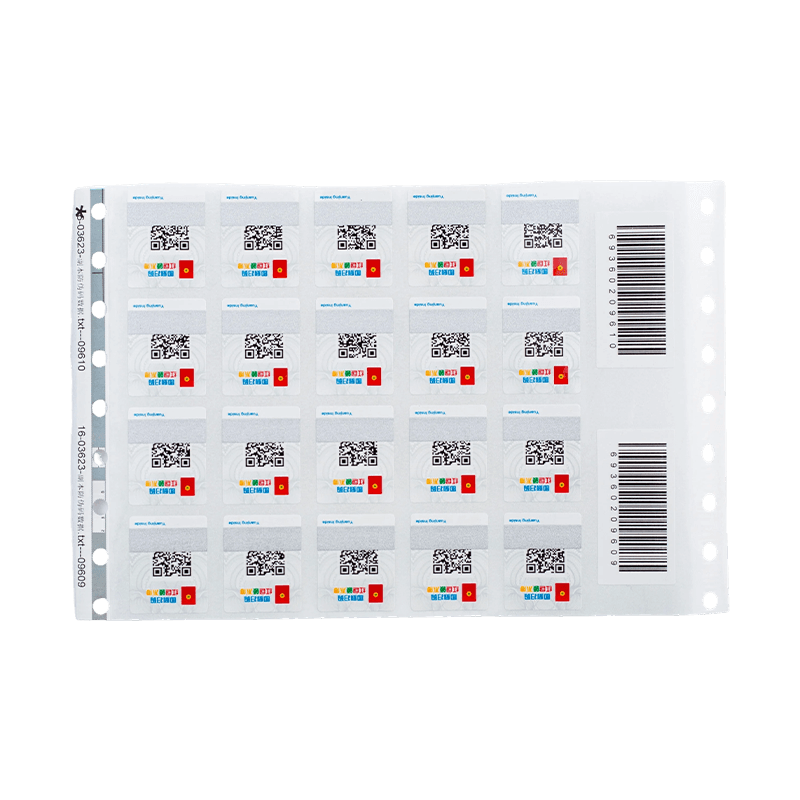 NFC Interactive Marketing LabelsAdvantages and Details: Built-in micro NFC chip allows consumers to instantly access a wealth of digital content—including the brand's official website, product tracea...View Product →
Encoding, Testing and Quality Control
An NFC sticker is only as good as the data written to it. Before production, agree on the NDEF structure, the destination URLs and whether the memory should be locked to prevent rewriting after encoding. Many programmes also record the chip's unique identifier alongside a batch number so that authentication checks can be audited later.
- Encode the NDEF payload and verify each record reads correctly.
- Confirm read range on the actual filled container, not on a bare sample.
- Test across multiple phone platforms and operating system versions.
- Run humidity, temperature and adhesion checks that match the real supply chain.
- Inspect encoded tags at the end of the line so no unreadable label leaves the factory.
Because the chip sits inside a printed laminate, quality control has to cover both electronics and graphics. A readable tag with a smeared barcode is still a rejected label.
From Specification to Shipment: Working With a Label Partner
The practical reality is that NFC stickers sit at the meeting point of two disciplines. They are printed labels and they are wireless devices, and the supplier needs to be comfortable with both. A manufacturer that produces pressure-sensitive labels and RFID smart labels in the same facility can tune the antenna, choose the adhesive and print the artwork in one controlled process, rather than assembling a product from parts sourced from three different vendors.
Shanghai Rongyang Industrial Development Co., Ltd. works in exactly that space, supplying pressure-sensitive labels and RFID smart labels with HF and UHF capability, from inlay and tag through to the finished label. Our team regularly supports customers from the first prototype to volume production, adjusting face material, adhesive and chip selection until the tap works reliably on the real package. We also meet packaging and brand teams face to face at trade shows, and a look at our exhibition schedule is often the fastest way to start a conversation about a new NFC programme.
NFC stickers are not a gimmick waiting for a use case. They are a mature, low-cost way to give a printed label a second job: confirming authenticity, answering a question, rewarding a customer or simply proving that a bottle came from where it claims. Get the antenna, the material and the placement right, and the technology disappears into the packaging where it belongs.


Messae Us Right Now!

- Quick Links
- Products
- Quality Control
- Our Story
- News
- Contact
- Our Product
-
- Beauty and Personal Care Labels
- Home cleaning and laundry care labels
- Liquor and Beverage Labels
- Food and dairy product labels
- Healthcare Labels
- Promotional and Interactive Labels
- Specialty and industrial solution
- Labels Thermal printing and logistics labels
- Anti-counterfeiting traceability and RFID Labels
- Contact us
- Tel:+86-573-86867861
- Phone:+86-18621872035
- E-mail:allen.men@rylabel.com
- Add:No. 111 Xincheng Road, Haiyan Economic Development Zone, Jiaxing City, Zhejiang Province


