
 English
  русский
  Español

Home / News / Industry News / Thermal Labels Explained: Materials, Printing Methods and Applications
News

Thermal Labels Explained: Materials, Printing Methods and Applications
2026-10-14
A thermal label looks like the simplest item in any packaging catalogue: a face material, an adhesive, a silicone-coated liner, and an image that appears when heat meets a carefully engineered coating. The simplicity is deceptive. Pick the wrong combination, and a barcode that scans perfectly on a packing line fades to grey after two weeks on a sunlit pallet, or a baggage tag peels away from a suitcase in the rain.
We have spent years producing pressure-sensitive and RFID labels for customers in food and beverage, pharmaceuticals, logistics and retail, and the questions we hear most often are rarely about how thermal printing works. They are about which material, adhesive and coating will still perform on day ninety, in a freezer, on a damp bottle, or inside an airport sorting hall. This guide gathers the practical answers we give in those conversations.
What Exactly Are Thermal Labels?
"Thermal labels" is a broad term for label stock designed to be printed by a thermal printer, using heat instead of ink, plates or a printing press. Because nothing touches the surface except the print head, the process is fast, quiet and well suited to on-demand variable data: tracking numbers, batch codes, weights, prices and identifiers that change on every single label.
Two printing routes dominate the market, and the labels used for them are not interchangeable.
Direct thermal
The label carries a heat-sensitive coating that darkens wherever the print head touches it. No ribbon is required, which keeps consumables simple and the cost per label low. The trade-off is durability: the image is chemically produced and can fade under heat, sunlight, friction and certain plasticisers.
Thermal transfer
A ribbon is melted onto the label surface, so the image sits as a wax, wax-resin or resin layer rather than a chemical reaction. The result resists abrasion, heat and solvents far better, provided the face stock and ribbon are matched correctly.
Direct Thermal vs Thermal Transfer: A Practical Comparison
| Consideration | Direct thermal | Thermal transfer |
|---|---|---|
| How the image forms | Heat-sensitive coating darkens under the print head | Ribbon is melted onto the label surface |
| Ribbon required | No | Yes, matched to the face stock |
| Typical readable life | Months in mild conditions | Years, including outdoor and industrial use |
| Heat and sunlight | Fades over time | Strong resistance |
| Abrasion and chemicals | Moderate | High with resin ribbons |
| Cost per label | Lower | Higher upfront, often cheaper over the asset's life |
| Common uses | Parcel labels, retail price and scale labels, baggage tags | Asset tags, laboratory and chemical labels, long-life barcodes |
Neither column wins outright. Direct thermal is usually the right answer when a label only has to survive hours or days and volume is high. Thermal transfer earns its cost when the label must outlive the season, the warranty period or the life of the equipment it identifies.
The Material Stack Matters as Much as the Printer
Most thermal label failures we are asked to investigate trace back to a mismatch inside the label construction, not to the printer. Four layers decide how the finished label behaves:
- Face stock: uncoated paper, top-coated paper for sharper images, or synthetic film such as PP and PET for moisture and tear resistance.
- Adhesive: permanent, freezer-grade, high-tack or removable, each with a different minimum application temperature and a different relationship with the surface it touches.
- Topcoat or varnish: protects the printed image from rubbing, moisture and handling, and can extend readable life considerably.
- Liner and die-cut format: roll direction, core size, spacing and winding all affect how smoothly a roll runs through a high-speed printer.
If you are still early in the specification process, our guide to adhesive label materials walks through these trade-offs in more detail.
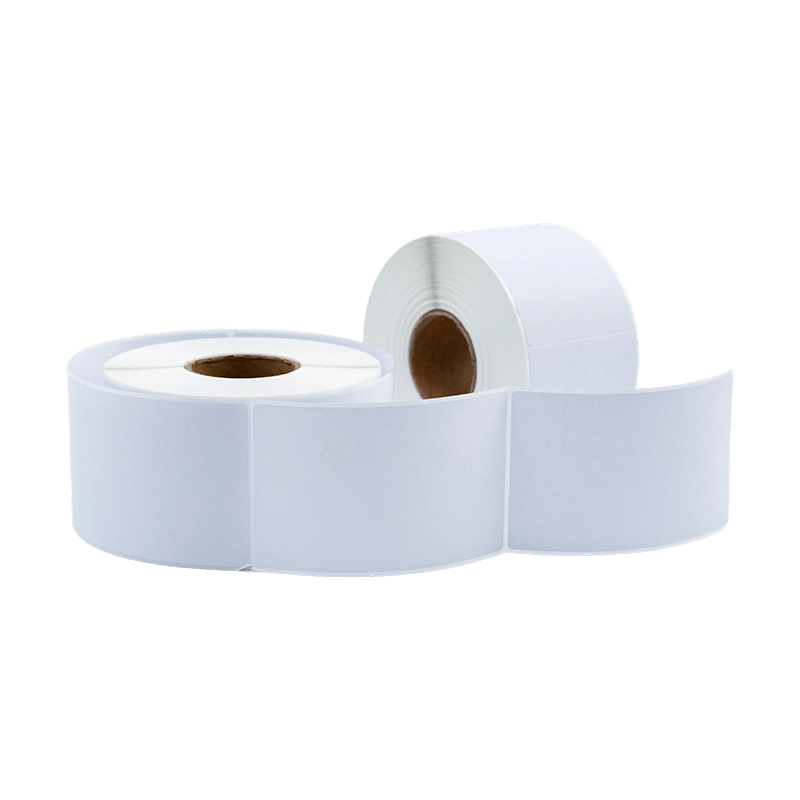 General-Purpose Blank Die-Cut Thermal Labels for LogisticsCost-effective, compatible instant-print labels for express waybills, warehouse picking and shipping box markings, suited to high-throughput logistics operations.View Product →
Where Thermal Labels Do Real Work
Parcel, pallet and baggage handling
Logistics is where thermal printing proved itself. A shipping label is printed in seconds, carries a unique barcode or QR code, and needs to survive conveyor belts, sorting chutes and stacking without losing contrast. On the air side of the same operation, baggage tags face an additional challenge: they are wrapped around handles, exposed to rain and pulled by mechanical readers, so the adhesive and the backing paper matter as much as the print.
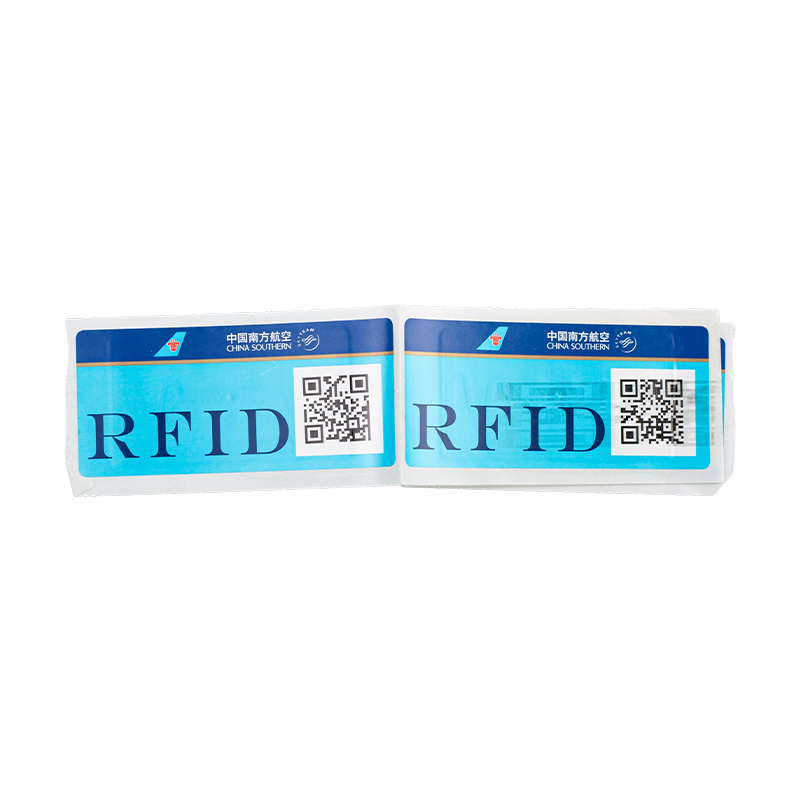 Airport Air Baggage Labels for Sorting and TransshipmentHigh-strength, heat-sensitive synthetic labels with strong adhesive for airport baggage sorting and transshipment, resisting moisture and tearing in global air transport.View Product →
Retail pricing and weighing
Counter scales and price guns generate thousands of small labels a day, each with a barcode, a price, a weight and sometimes a use-by date. These labels have to be printed at speed, applied to damp packaging, and stay legible until the customer reaches the till. Consistent die-cutting and a liner that releases cleanly keep those printers running instead of stopping for a jam.
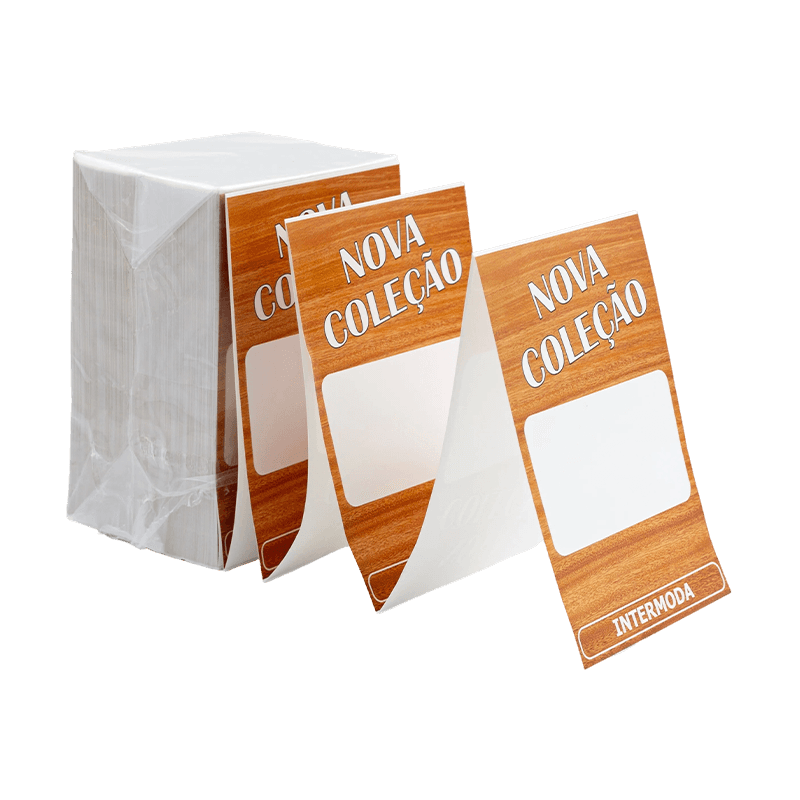 Supermarket Price Thermal Printing Labels for Shelf TagsWear-resistant, non-curling thermal cardstock labels for retail shelf price slots, supporting centralized price data and rapid local adjustments.View Product →
Cold chain, healthcare and industrial surfaces
Frozen food cartons, laboratory sample tubes, sterilised medical packaging and oil drums all push thermal labels in different directions. Freezer adhesives have to grip at temperatures well below zero, medical labels need clean edges and reliable legibility, and industrial surfaces may be curved, oily or chemically aggressive. In each case, the specification process is the same: describe the environment honestly, then test.
A Short Checklist Before You Request Samples
- Name the surface: paper, film, glass, metal, curved or textured, clean or contaminated.
- State the temperature range the label will experience, from application to storage to removal.
- Describe the environment: moisture, condensation, direct sun, oil, solvents or abrasion.
- Set the readable life you actually need, in weeks or years.
- Confirm the printer technology and the ribbon you intend to use.
- Share the roll format, core size and expected print speed or volume.
Answers to those six points usually narrow the field to two or three viable constructions, and samples can then be tested under realistic conditions rather than in a meeting room.
How We Approach Thermal Label Projects
Rongyang produces pressure-sensitive labels and RFID smart labels from Shanghai for customers across fast-moving consumer goods, food and drink, pharmaceuticals, logistics and retail. Our production runs on automatic lines with precision inspection equipment, and an in-house engineering team works alongside customers to develop constructions that meet a specific environment rather than a generic specification.
That means we are just as comfortable adjusting an adhesive for a freezer tunnel or a damp bottle as we are producing standard roll stock in high volume. We also supply RFID inlays, tags and finished labels in both high-frequency and ultra-high-frequency formats, which is useful when a barcode label and a tracking tag need to sit on the same shipment.
Much of this starts face to face. You will find us at industry exhibitions through the year, and we are always glad to talk through a tricky application before a purchase order exists.
Questions We Hear Most Often
Can a direct thermal label be made more durable?
Yes, up to a point. A protective topcoat and a synthetic face stock can substantially delay fading and smudging, but if a label must remain readable for years, thermal transfer with a resin ribbon is usually the more dependable route.
Why do my labels jam or print unevenly?
It is often a mechanical issue rather than a material one. Check printer calibration, print head pressure and platen condition first, then look at liner release, roll winding tension and die-cut consistency.
Do I need a custom construction, or will a standard one do?
Standard stock covers a surprising number of applications. Custom constructions earn their place when temperature, chemicals, surface texture or shelf life fall outside the normal range.
Thermal labels reward a little planning. Decide what the label has to survive, choose the printing route that matches that requirement, and specify the material stack around it. If you would like a second opinion on a construction, or samples to test on your own line, our team is happy to help — send us the details of your application and we will suggest a starting point.


Messae Us Right Now!

- Quick Links
- Products
- Quality Control
- Our Story
- News
- Contact
- Our Product
-
- Beauty and Personal Care Labels
- Home cleaning and laundry care labels
- Liquor and Beverage Labels
- Food and dairy product labels
- Healthcare Labels
- Promotional and Interactive Labels
- Specialty and industrial solution
- Labels Thermal printing and logistics labels
- Anti-counterfeiting traceability and RFID Labels
- Contact us
- Tel:+86-573-86867861
- Phone:+86-18621872035
- E-mail:allen.men@rylabel.com
- Add:No. 111 Xincheng Road, Haiyan Economic Development Zone, Jiaxing City, Zhejiang Province


